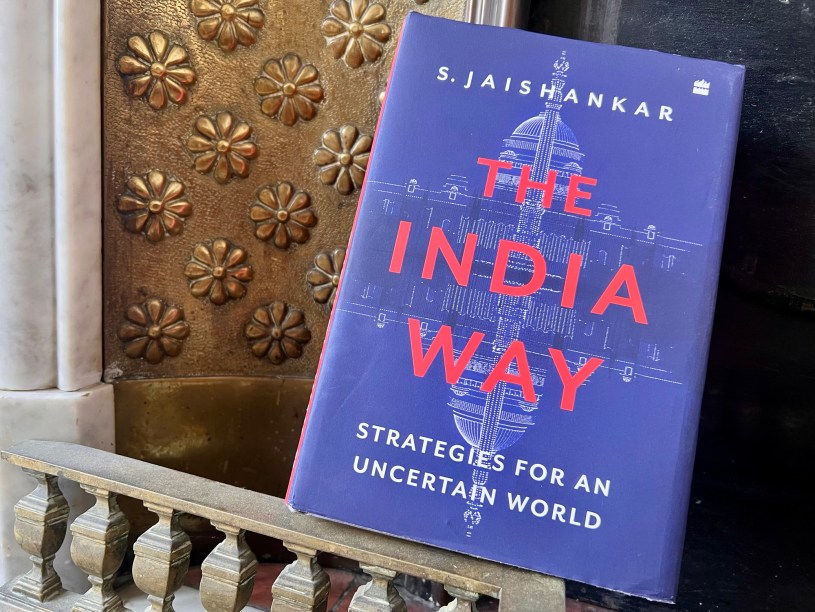
Here is a book too important to ignore. India has over 1 billion inhabitants, and the author is the country’s External Affairs Minister after a very long career in international diplomacy. As he puts it in the very first words, “As India rises in the world order, it should not only visualize its interests with great clarity but also communicate them effectively. This book is an effort to contribute to that endeavour, encouraging an honest effort among Indians, without discouraging the world from eavesdropping.” And when a smart External Affairs Minister of a top world power offers one the occasion to eavesdrop… one takes it.
Now, eavesdropping is no easy feat. It requires following a conversation not aimed at you and catching words and ideas as they go. The book makes many references to Indian history, culture and mythology, taking them for granted. The author did not write an educational book for the Western reader. Indeed, it is intended for his fellow compatriots. This makes reading this collection of conference texts even more interesting.
In a nutshell, S. Jaishankar acknowledges that the world is changing towards multipolarity. The dual world of the USA and the USSR (let’s say from 1950 to 1991) had given way to a globally unified world under United States rules (let’s say from 1991 to 2016), and it is now apparent that we are witnessing the rise of a new world power (China), leading to a multipolar situation. Truth be told, this multipolarity is closer to the long-term human norm, if any context may be considered normal. In this situation, India is rising, coming forward, and aims at being multi-aligned, meaning maintaining good positive relationships with all neighbours and powers, each on themes relevant to Indian interests.
In this new world, China is a model. The author recognizes that it has risen economically and technologically much faster than India. It conquers the world with trade surpluses rather than by shedding blood. And while he never suggests India should copy China, it is clearly the example to draw inspiration from in this volatile moment, where he believes “the next decade will unfortunately be less generous and more unsafe” and also “greater players will not mean better rules; probably quite the opposite.”
Hearing about geopolitics from an Indian citizen is somewhat refreshing for the European reader. I am used to reading Americans, but I rarely get the Asian point of view. I note that the author considers Europe as “highly regarded for its industrial strength and quality of products” and “punching below its weight.” Nothing really new here. Thus, what may you see in this book that you may not get elsewhere?
First, reading suggestions. Have you read the Mahabharata (for India) and Three Kingdoms (for China)? I know I have not. S. Jaishankar asserts that they are as important for Indian and Chinese views of the world as Homer’s Iliad or Machiavelli’s The Prince are for Westerners. These cultural references are just too important to be ignored. They may be good adds to the summer reads.
Second, considerations you may not read elsewhere. The author insists, with regard to Indian culture, on the importance of following the process and on the fairness of the outcome. He seems to imply that the end does not justify the means. At least not in the Indian unconscious value system: “In India, we also meet an obsession with words and text. Form and process are often deemed more important than outcomes.”
As a side note, if Europe manages to maintain, in the long term, its principle of respecting the rule of law in a global context where the USA or China – to take specific examples – may not, it puts India as a strong natural ally for Canada and the European Union. The author indeed concludes his second conference – the Art of the Disruption – with this sentence: “Being an ethical power is one aspect of the India Way.”
In his third conference, the author mentions six phases of recent Indian history. I always find it interesting to note how someone articulates the history of his country. Here are the six phases:
- 1946-1962. Optimistic non-alignment. India’s objectives were to resist the constraining of choices and dilution of its sovereignty.
- 1962-1971. A decade of realism and recovery. India made more pragmatic choices on security and political challenges while addressing a paucity of resources.
- 1971-1991. Greater Indian regional assertion. It started with the decisive dismantling of an India-Pakistan equivalence through the creation of Bangladesh, but ended with the IPKF misadventure in Sri Lanka.
- 1991-undefined. The dissolution of the USSR and the emergence of a “unipolar” world.
- Undefined-2014. Gradual acquisition of the attributes of a balancing power. The India-US nuclear deal and common cause with China on climate change and trade, while consolidating ties with Russia.
- 2014+. Top world power shift. China gains momentum while the American trumpet sounds uncertain.
Interestingly, moving towards an uncertain multipolar world is seen as an opportunity for India. The author notes that “A changing world is clearly a more actionable one for those who do not wish to get left behind.” And indeed, this new situation may not disadvantage India more than the previous paradigm. At some point, he goes so far as to openly criticize the West: “in dealing with the West, the Chinese often invoke a century of humiliation to justify their positions now. But if anybody should be complaining, it should be India, which saw two – not one – centuries of rape and pillaging by Europe. This despoiling of a leading economy of its times is still to be widely appreciated.” Though the book is overall forward-looking, balanced and polite, the specific page of the fifth conference, “Of Mandarin and Masses,” clearly displays resentment. Or rather, a competing narrative. In the last lines of this same conference, the author notes, “As India goes up the international order, it will advance its own narratives, and, on occasion, question Western ones.” We are moving towards an even more interesting world.
Is this all? No, far from it. The text goes at length into relationships with Pakistan, recent Indian history, border issues and Indian sea management. These are topics highly relevant to someone living in the region, possibly less so to the eavesdropping reader.
Thus, I would encourage you to read the book. You would probably pick up much more and certainly additional topics. And you would learn a bit more about this rising, important culture of India. Let’s leave the last word to the author, quoting the book’s very last line: “So let us take it as a sign of the times that the world has discovered the virtue of Namaste, the India Way of greeting with folded hands.”
En savoir plus sur Curatus read
Abonnez-vous pour recevoir les derniers articles par e-mail.

