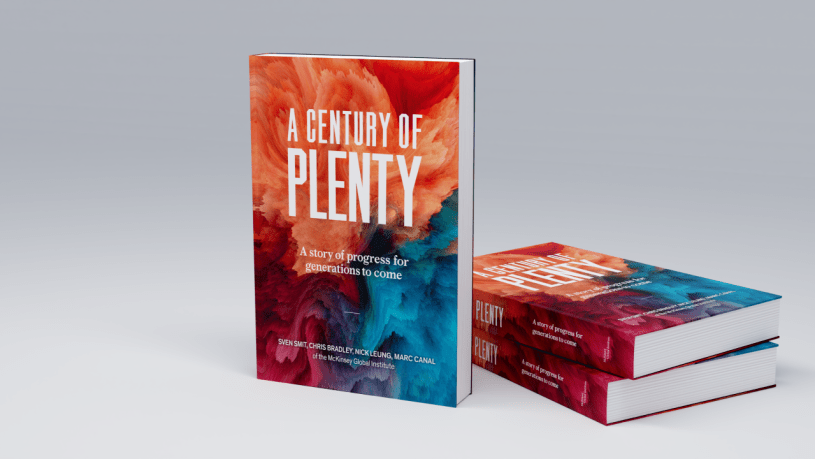
Enfin un discours positif !
Ce livre important propose de prendre le contre-pied d’une certaine morosité ambiante et d’affirmer que les cent prochaines années de l’humanité formeront une époque exceptionnelle de prospérité. Les auteurs prennent la Suisse d’aujourd’hui pour modèle et estiment que tous les pays du monde devraient se donner l’ambition de fournir à leurs citoyens du siècle prochain au moins ce niveau de vie : une société stable où l’épanouissement de chacun est permis dans un cadre environnemental préservé.
Impossible et naïf ? Peut-être pas. Les auteurs invitent les lecteurs à comparer 1925 et 2025. Le siècle dernier a permis une amélioration indéniable des conditions de vie de presque tout le monde sur terre. Dans presque tous les pays et pour presque toutes les classes sociales. Qui préférerait vivre en 1925 et oserait affirmer vouloir revenir en arrière ? Dès lors, pourquoi s’interdire de penser que les cent prochaines années ne pourraient pas apporter des bénéfices comparables ? Le sous-titre annonce la couleur : “A Story of Progress for Generations to Come”.
Tout au cours de l’ouvrage, les auteurs font passer cinq messages :
- L’opportunité d’un siècle d’abondance est réel. Bien des régions du monde ne sont encore qu’au début de leur développement. Offrir la qualité de vie de la Suisse au monde entier suppose une multiplication par huit de la création de richesses annuelles.
- La croissance est une bonne chose. La croissance économique est corrélée positivement à un très grand nombre d’indicateurs, de l’éducation à la liberté de choisir sa vie aux opportunités disponibles et au bonheur. Et aussi à la décarbonation et au respect de l’environnement. Nous devons rechercher cette croissance.
- Il y a assez pour tout le monde. Des terres agricoles aux ressources minières et mêmes à ces terres dites rares, on trouve des réserves quand on explore et des solutions quand on les cherche. À l’échelle planétaire, il n’existe pas de limite insurmontable. Même celle du climat pour laquelle une énergie décarbonée abondante et la mise en place de technologies aujourd’hui en développement solutionne bien des problèmes.
- It’s time to build our future. C’est à nous de prendre un ensemble de décisions pour lesquelles nos enfants et petits-enfants nous remercieront.
- It starts with a new story. On trouve facilement des discours défaitistes et déclinistes. Il existe une autre histoire à raconter : une histoire expansive, porteuse d’un potentiel encore inexploré, guidée par un sentiment d’optimisme, toujours ancré dans les faits.
Nous vivons à un moment charnière comme l’a pu également être 1990. Et c’est précisément à ces moments charnières, comme celui que nous vivons aujourd’hui, que nous nous ajustons, relançons la machine du progrès et écrivons un nouveau récit de l’avancement.
Curatus est une initiative pour faire lire aux professionnels plus d’ouvrages… professionnels. Et une maison d’édition qui publie Le guide des livres business, ainsi que d’excellents titres à découvrir ici.
Le texte ci-dessous contient des notes écrites pour moi sur la base de citations choisies au sein du livre. Elles reprennent quelques éléments dont j’ai choisi de me souvenir. Elles ne représentent cependant ni un résumé ni une synthèse. Lisez A Century of Plenty !!!
1925-2025 – cent ans formidables
Quelques exemples de ce qui n’existait pas en 1925 : « 1925: air travel, ballpoint pens, talking movies, credit payments, tampons, oral contraceptives, disposable diapers, refrigerators, vacuum cleaners, washing machines, microwaves, televisions, zippers, health insurance, social security, or insulin, not to mention plastic bags, bottles, and utensils, or vaccines for polio, measles, mumps, rubella, flu, tetanus, or diphtheria. In 1925 America, only about one in five adolescents graduated from high school, and one in five adults owned a car. Less than half of households had indoor plumbing, and only about half had access to electricity—10 percent in rural areas. ». Et s’il vous venait à l’esprit de penser que cette liste semble très occidentale, Sven Smit rappelle que dans bien des pays – pensez à l’Inde, la Chine ou l’Afrique subsaharienne – le contraste est encore plus extrême.
La croissance est une bonne chose
Les auteurs affirment que la croissance économique est une bonne chose et un excellent indicateur. Certes, il n’intègre pas tout dans son calcul, mais ce qu’il laisse de côté lui est corrélé. Plus une société produit de richesse, plus elle peut se permettre l’art, le social, le sport, le temps libre et la longue liste de tout ce qui fait la qualité de vie et que l’on reproche – à raison – aux indicateurs économiques d’ignorer.
Sven Smit n’ignore pas le procès fait au progrès et prend le temps de répondre un à un aux arguments en imaginant un procès à ce sujet : « The main charges we see are that economic progress has been unequal and left many people behind; that our climate can’t handle it; that progress causes too much deterioration in the natural environment; and that in any case it doesn’t really make us happier. Let the trial begin!”
La croissance signifie énergie
Le climat est probablement l’argument le plus sérieux à l’encontre du progrès. Et Sven Smit ne dément ni le réchauffement climatique ni l’argument principal de Jean-Marc Jankovici dans Un Monde Sans Fin : qui dit croissance dit énergie. La croissance économique humaine est directement liée à notre consommation de joules. Les auteurs ici présentent cela comme une loi d’airain.
“There is simply no way to grow an economy without growing energy. Let us repeat: Energy makes the world go around. “
“no economy has ever thrived without increasing its energy use, and that’s unlikely to change in the decades ahead.”
Il faut croire en une croissance verte
The energy revolution has indeed driven rising greenhouse gas emissions, particularly CO2. In 1925, global greenhouse gas emissions in CO2-equivalent (CO2e) tonnes from fossil fuels and industry were about five billion tonnes per year. By 2024, this figure had surged to about 57 billion tonnes. Some of the change was due to population growth, but growing energy consumption per person played a big role, too. Cumulative emissions have warmed the planet by approximately 1.2°C above preindustrial levels, with cascading effects on climate systems.”
À ce sujet, ils développent une argumentation technologiste assez proche de celle de Bill Gates dans « How to Avoid a Climate Disaster » : il nous faut une énergie propre et abondante. Bonne nouvelle : nous n’en sommes plus si loin. La France est citée en exemple pour le nucléaire – technologie qui se développe à nouveau dans bien des pays qui réouvrent des centrales. Le coût de production des énergies renouvelables continue de chuter. Et la fusion pourrait un jour être maîtrisée. Une fois qu’une énergie propre et quasi illimitée est disponible, une énergie décarbonée devient envisageable. Et bien des procédés permettent d’emprisonner le carbone plutôt que de le dégager dans l’atmosphère. Il suffit souvent de les mettre en place. C’est long, coûteux et réclame de l’énergie. Mais ce n’est pas – selon les auteurs – technologiquement hors de portée.
« As usual, technology is our biggest weapon. Solar and wind costs have plummeted by 88 and 74 percent, respectively, in just 15 years, making them some of the cheapest point sources of new electricity in many regions. Nuclear energy remains a reliable and underutilized low-carbon option, with countries like France deriving about 70 percent of their electricity from it.68 Emerging technologies, such as carbon capture, utilization, and storage (CCUS), low-emissions hydrogen, and new battery chemistries, hold promise for decarbonizing hard-to-abate sectors like heavy industry and aviation. If adoption accelerates, these innovations could significantly curb emissions. All of these are what we call progress and are enabled by economic growth. »
Par ailleurs, les auteurs insistent sur le fait qu’enrichir les pays est le meilleur moyen de protéger l’environnement. Les pays riches font plus attention que les pays pauvres à leur environnement. Parce qu’ils ont les moyens et l’éducation de le faire. Les pires problèmes environnementaux se trouvent aujourd’hui dans des pays en transition. Mais dès qu’ils atteignent un certain niveau de richesse, les populations de ces pays s’intéressent au sujet. Il se peut qu’il existe une difficile période d’entre deux, mais c’est le prix à payer. Les auteurs écrivent « Ocean plastics come not from the countries that use more of the materials but from those that do not have the resources to devote to waste management—in other words, countries that lack economic progress. ». Je l’ai vu de mes yeux à la fin des années 2010 au Panama dans une zone indigène censée protégée. De même pour les mines : “Dirty, inefficient mines are not the price of progress; they are something we grow out of.”
Il y a assez de ressources pour tout et tous
Sven Smit rappelle que l’argument selon lequel on tomberait à courts de ressources n’est pas nouveau. Et que chaque fois que l’on a cherché, on a trouvé.
“Skeptics have long warned of looming shortages, finite geological deposits, geopolitical risks, and environmental constraints, as we discuss later. It is true that declining ore quality or slow discovery could raise costs and complicate scaling. But to date, many dire predictions haven’t materialized. In the 1950s, scientists claimed that the United States would reach “peak oil” in the 1970s. Yet oil continued to grow. Peak oil did not happen due to technological advances like hydraulic fracturing and to new discoveries from the North Sea to shale basins. In fact, oil supply has expanded, and, despite volatility, prices have remained affordable for industry and consumers.”
Même les soi-disant terres rares qui lui paraissent une appellation journalistique plus qu’une réalité scientifique.
“Rare earth elements are not rare. Their name comes from the fact that they are present in rock in tiny concentrations, not because they are uncommon. Reported reserves are bigger than needed to meet expected long-term demand. But we need to be a little careful. Reported reserves are for all 17 rare earths. Only four of these are crucial for magnetic application—neodymium, praseodymium, dysprosium, and terbium, which are used in EV motors, wind turbines, and emerging technologies like portable MRI machines. Other rare earths, like cerium and lanthanum, are abundant but not as useful. There is another caveat. Because these magnetic rare earths appear in such low concentrations in ore, their processing is complex and expensive. Moreover, geopolitical tensions already affect rare earth supply chains. In short, sourcing rare earths is more complicated than the simple finding that reserves are more than enough for what we need. The hope is that some of those issues can be solved through more innovation and investment, which are more likely to occur as demand rises. As Plato wrote, need is the true creator. »
La baisse des réserves parfois pointée du doigt par les journaux est une baisse des réserves prouvées. Le cycle suivant d’exploration les fera remonter : “No matter which material you are talking about, we have found more when we have looked for more.” “The few materials that demand attention are not likely to be geological bottlenecks. They pose scaling challenges. And with the right investment, innovation, and coordination, they are likely within our reach.”
Quid du pétrole ? Pour les auteurs, il ne faut pas en utiliser dans le mix énergétique. “In a century of plenty, oil is fully phased out as an energy source while natural gas supplies 10 percent of primary energy, as we have previously discussed. We assume modest efficiency gains, which moderate the rise in consumption even as global energy demand grows.”
Une nouvelle ère
Les auteurs ne remettent pas en cause le tournant que marquent les années 2020-2025. Ils appellent la période 1990-2020, l’âge du marché. Ce moment où démocratie et économie libérale semblaient le seul et unique modèle viable et enviable.
“At the end of the era of markets, the world has hit a set of new majorities. The vast majority of people are connected to smartphones and the internet. The majority of economic activity is traded, the majority of people consume at least 30 gigajoules of energy per year, and the majority of people live in cities and work outside agriculture. “
“We have become so accustomed to the era of markets that we could be excused for thinking that this is the way of the world. But as this short, guided tour of our century of progress has shown, it was really just one special chapter in a diverse book. Things we used to take for granted were temporary artifacts of a world that was temporarily unipolar, at its demographic sweet spot, and with massive headroom for growth in China and India as they entered the global economy.”
“Without doubt, a lot is new or unfamiliar. When confronted by an alternative reality, it has become the stuff of popular legend that the crew of the Starship Enterprise observed, “Jim, this is our world, but not as we know it.” That is what it is like to live in a new era.”
“The early days of a new era can be unnerving. For all of us authors, and we suspect most of our readers, our lives have played out on a relatively consistent landscape. But our known rulebooks no longer apply. We might be experts at the wrong game and novices at the new one. The challenge of all inflection points is to rethink, recalibrate, and make the right choices.”
Cependant : “We do not believe that there are physical limits to delivering this century of plenty. We can have the energy, materials, food, and innovation we need to make it reality.”
5 principes pour le futur
The times in which we write are uncertain. People, especially in mature economies, seem to be losing hope. The Edelman Trust Barometer Survey that we quoted in chapter 13 found that only 30 percent of Americans, 14 percent of Germans and Japanese, and a paltry 9 percent of the French say that “compared to today, the next generation will be better off.” Increasingly, people appear to have stopped believing in our machine of progress. And for good reasons, which we have discussed. Many people feel left behind. We are at an inflection point, entering a new era, living through rapid changes. Not only is this scary and unsettling, but it affects people’s livelihoods. Hopelessness can also become self-fulfilling, trapping us in a zero-sum sociopolitical stasis. We set out armed with a sense of what might be possible.
In that spirit, let us leave you with five propositions: The opportunity for a century of plenty is real. Growth is good. There is enough for all. It’s time to build our future. It starts with a new story. We can write a narrative of scarcity or a narrative of plenty. We know where our hearts lie.
Les 5 principes une seconde fois :
- The opportunity for a century of plenty is real.
- Growth is good.
- There is enough for all.
- It’s time to build our future.
- It starts with a new story.
Le besoin d’un nouveau narratif
Les auteurs ne nient pas la morosité ambiante. Notamment de l’occident à son propre sujet. Pour autant, ils se veulent optimistes. Les années 1970s étaient moroses également. En 1925, on se dirigeait vers la crise de 1929, les années 1930 et la seconde guerre mondiale. La période 1925-1945 peut donc difficilement – vue d’Europe – être prise en exemple comme un âge d’or. Et pourtant, sur cent ans on change de focale. La comparaison 2025-1925 est frappante. Aussi, il nous appartient de rester optimistes et voir plus loin.
“Our goal should be to establish a new narrative of progress at this time of disequilibrium.” “Ultimately, it is about the most important belief of all: belief in the future.”
“Some narratives risk thwarting our chances of success. Growth is a good thing, not an enemy of a high quality of life but its guarantor. Our economy is not zero-sum; everyone can have more. The planet is not a limiting factor so long as we build a new, expanded, cleaner energy system, lifting our sights beyond mere replacement to building big. The new narrative of progress should be ambitious, fearless, can-do. We need to write it. Let’s pick up the pen, not with a dread of writer’s block, but with excitement about the words that will flow onto the page.”
“This erosion of trust, of belief in progress itself, is one of the core reasons we have written this book. In our own small way, the qualified (and quantified) optimism of this book hopes to counter a slide into pessimism and inertia. We do need to upgrade the progress machine. But if the next century is to be one of abundance, it will also require a cultural shift, a narrative reset, a renewed “culture of growth.””
“At moments of historical transition, shared narratives become the scaffolding for renewal. This is one of those moments. This won’t come from consensus on every issue; disagreement is healthy and necessary. But it will come from a renewed commitment to common purpose, rooted in first principles: that prosperity is possible, that innovation matters, and that investing in the future is both a moral and a practical imperative.”
Le challenge de notre époque : la croissance verte
“The best way to combat global warming is not to arrest growth but to use growth to accelerate away from our dependence on fossil fuels. If we do that with vigor, we can limit global warming and achieve a century of plenty.”
« Therefore, the defining challenge of our age is to decouple economic growth from the emission of greenhouse gases.” “with improving energy efficiency, growth does not need to be at the expense of our planet.”
“Perhaps many more people will produce art and entertainment instead of working behind a desk.”
Pas facile, mais faisable et désirable
« These challenges are real, but we remain optimistic. First, because it would be foolish to bet against human ingenuity. We are undoubtedly fallible, but we have proven, time and again, our capacity to solve the toughest problems. Second, because history shows the way to the future. Put yourself back in 1925, when the world was still recovering from a global war and unknowingly heading toward another one, with challenges much more serious than the ones we face today. Yet, 100 years later, we have experienced unprecedented progress in almost every place, across virtually every dimension. »
“If there is one thing that the past 100 years has shown us, it is that growth isn’t just about incomes. It means that people can live more secure, healthier, empowered lives. It broadens our life experience. We gain access to ideas, to other cultures, to other people, to choice. Growth expands our possibilities. A world without growth is one in which we must make choices about who gets the benefits of progress and who is left behind. We cannot forge toward a century of plenty if one person’s gain is another person’s loss. A world of winners and losers.”
“We have built the present, and we can build the future. Europe rebuilt after World War II. China built a modern economy in a few decades. Texas builds more renewable energy projects each month than the rest of the top ten US states combined.169 When we decide to build, we do it.”
Pas facile, mais faisable et désirable
“It’s not hard to find stories today that are about worry and even fear, of limits and boundaries, of reining in rather than letting loose. There is another story to tell, one that we share. An expansive story of potential yet to be tapped, guided by a sense of optimism, always based on facts. It is precisely at these inflection points, like the one we are in today, when we adjust, refresh the progress machine, and write a new narrative of progress.”
“At the most fundamental level, we have a responsibility to make decisions for which our children and grandchildren will thank us.”
En savoir plus sur Curatus read
Abonnez-vous pour recevoir les derniers articles par e-mail.
 Curatus read