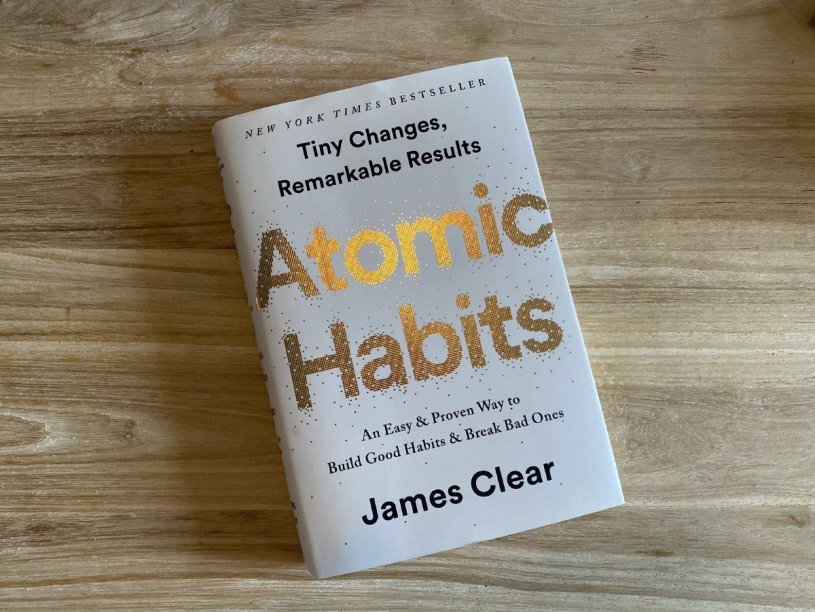
Quand un livre annonce plus de 20 millions d’exemplaires vendus et que sa page Amazon affiche plus de 170 000 commentaires, soit le monde entier est devenu fou, soit c’est une lecture recommandable. Sans hésitation, Un rien peut tout changer – le titre français – appartient à la seconde catégorie.
Avant d’écrire ce livre, l’auteur a tenu pendant des années une newsletter régulière sur un unique thème devenu une passion : les habitudes. Une habitude est un comportement qui a été répété suffisamment de fois pour devenir automatique. Selon l’auteur, nous sommes ce que nous faisons de manière constante. Et presque toutes nos actions sont le résultat d’une habitude. James Clear s’est intéressé à comment elles nous définissent et nous limitent ; comment elles nous servent et nous desservent ; comment nous pouvons les faire et les défaire ; et donc comment les modeler pour atteindre nos objectifs. Ce livre concentre le meilleur de toutes ses newsletters.
Il postule que nos habitudes se fondent sur un modèle en quatre étapes : signal, désir, réponse et récompense. Pour changer vos habitudes, l’auteur vous proposera de commencer par les observer. Ensuite, il expliquera chapitre par chapitre comment influencer positivement ou négativement chaque étape afin de créer ou défaire une routine. Par petites touches ; un pourcent à la fois ; un rien à la fois ; un atome à la fois – le titre du livre.
C’est en effet ce focus sur l’atome qui donne son titre à l’ouvrage et qui change tout. L’auteur rappelle qu’il est facile de sous-estimer l’importance de chaque pierre pour bâtir l’édifice. Un cours de chant ne fera pas de vous un chanteur, mais un cours par semaine pendant deux ans finira par vous permettre d’être reconnu comme capable de chanter mieux que la moyenne. Quel que soit votre point de départ. James Clear suggère donc de vous intéresser à la direction, la trajectoire et la répétition, plutôt qu’à l’objectif.
Les objectifs que nous nous donnons sont lointains et pas toujours atteignables. Et nous en sommes souvent déçus après les avoir atteints. Plutôt que de souhaiter gagner au jeu, l’auteur vous propose de souhaiter prendre plaisir à jouer tout en améliorant continuellement ce qu’il appelle votre système, donc vos habitudes. Au passage, il fournit une myriade de suggestions intéressantes. Par exemple réorganiser son environnement pour que les bonnes habitudes soient faciles à prendre et les mauvaises habitudes difficiles, voire impossible. Autre exemple : construire une nouvelle habitude sur une routine déjà existante. Un dernier : combattre l’ennui. C’est l’ennui le véritable ennemi des bonnes habitudes.
Pour d’autres exemples, lisez le livre ! Il est clair, didactique, applicable, bien écrit, illustré, détaillé et jamais naïf. James Clear se fonde sur l’état de la science sans prétendre avoir inventé les concepts qu’il expose : il est un passeur d’information. En témoigne le fait qu’il ne cache pas que son modèle en quatre étapes est une version à peine adapté de des trois étapes de The Power of Habits de Charles Duhigg – précédemment recommandé dans ce guide sous le titre Le pouvoir des habitudes chez Flammarion – qui était lui-même une vulgarisation des travaux de B. F. Skinner dans les années 1930. Bref, James Clear n’a rien inventé, mais c’est lui qui l’explique le mieux.
Quelle que soit l’habitude que vous souhaitez développer ou arrêter, faites un premier pas en confiance : lisez Atomic Habits !
— Quelques notes de mon Kindle, donc des copier coller du livre pour mon usage personnel. Encore une fois. Lisez le livre !
- Maybe there are people who can achieve incredible success overnight. I don’t know any of them, and I’m certainly not one of them.
- Every action you take is a vote for the type of person you wish to become.
- The most practical way to change who you are is to change what you do.
- The backbone of this book is my four-step model of habits—cue, craving, response, and reward—and the four laws of behavior change that evolve out of these steps. Readers with a psychology background may recognize some of these terms from operant conditioning, which was first proposed as “stimulus, response, reward” by B. F. Skinner in the 1930s and has been popularized more recently as “cue, routine, reward” in The Power of Habit by Charles Duhigg.
- This can be a difficult concept to appreciate in daily life. We often dismiss small changes because they don’t seem to matter very much in the moment. If you save a little money now, you’re still not a millionaire. If you go to the gym three days in a row, you’re still out of shape. If you study Mandarin for an hour tonight, you still haven’t learned the language. We make a few changes, but the results never seem to come quickly and so we slide back into our previous routines. Unfortunately, the slow pace of transformation also makes it easy to let a bad habit slide. If you eat an unhealthy meal today, the scale doesn’t move much. If you work late tonight and ignore your family, they will forgive you. If you procrastinate and put your project off until tomorrow, there will usually be time to finish it later. A single decision is easy to dismiss.
- You should be far more concerned with your current trajectory than with your current results.
- Your outcomes are a lagging measure of your habits. Your net worth is a lagging measure of your financial habits. Your weight is a lagging measure of your eating habits. Your knowledge is a lagging measure of your learning habits. Your clutter is a lagging measure of your cleaning habits. You get what you repeat.
- If you want to predict where you’ll end up in life, all you have to do is follow the curve of tiny gains or tiny losses, and see how your daily choices will compound ten or twenty years down the line. Are you spending less than you earn each month? Are you making it into the gym each week? Are you reading books and learning something new each day? Tiny battles like these are the ones that will define your future self.
- Good habits make time your ally. Bad habits make time your enemy.
- Knowledge compounds. Learning one new idea won’t make you a genius, but a commitment to lifelong learning can be transformative.
- Habits often appear to make no difference until you cross a critical threshold and unlock a new level of performance. In the early and middle stages of any quest, there is often a Valley of Disappointment. You expect to make progress in a linear fashion and it’s frustrating how ineffective changes can seem during the first days, weeks, and even months. It doesn’t feel like you are going anywhere. It’s a hallmark of any compounding process: the most powerful outcomes are delayed.
- This is one of the core reasons why it is so hard to build habits that last. People make a few small changes, fail to see a tangible result, and decide to stop. You think, “I’ve been running every day for a month, so why can’t I see any change in my body?” Once this kind of thinking takes over, it’s easy to let good habits fall by the wayside. But in order to make a meaningful difference, habits need to persist long enough to break through this plateau—what I call the Plateau of Latent Potential.
- When you finally break through the Plateau of Latent Potential, people will call it an overnight success. The outside world only sees the most dramatic event rather than all that preceded it.
- All big things come from small beginnings. The seed of every habit is a single, tiny decision.
System over goals
Goals are about the results you want to achieve. Systems are about the processes that lead to those results. Now for the interesting question: If you completely ignored your goals and focused onl on your system, would you still succeed? For example, if you were a basketball coach and you ignored your goal to win a championship and focused only on what your team does at practice each day, would you still get results? I think you would.
The goal in any sport is to finish with the best score, but it would be ridiculous to spend the whole game staring at the scoreboard. The only way to actually win is to get better each day. In the words of three-time Super Bowl winner Bill Walsh, “The score takes care of itself.” The same is true for other areas of life. If you want better results, then forget about setting goals. Focus on your system instead.
What do I mean by this? Are goals completely useless? Of course not. Goals are good for setting a direction, but systems are best for making progress. Goal setting suffers from a serious case of survivorship bias. We concentrate on the people who end up winning—the survivors—and mistakenly assume that ambitious goals led to their success while overlooking all of the people who had the same objective but didn’t succeed. Every Olympian wants to win a gold medal. Every candidate wants to get the job. And if successful and unsuccessful people share the same goals, then the goal cannot be what differentiates the winners from the losers. It wasn’t the goal of winning the Tour de France that propelled the British cyclists to the top of the sport. Presumably, they had wanted to win the race every year before—just like every other professional team. The goal had always been there. It was only when they implemented a system of continuous small improvements that they achieved a different outcome.
Every Olympian wants to win a gold medal. Every candidate wants to get the job. And if successful and unsuccessful people share the same goals, then the goal cannot be what differentiates the winners from the losers. We think we need to change our results, but the results are not the problem. Fix the inputs and the outputs will fix themselves.
The implicit assumption behind any goal is this: “Once I reach my goal, then I’ll be happy.” The problem with a goals-first mentality is that you’re continually putting happiness off until the next milestone. I’ve slipped into this trap so many times I’ve lost count. For years, happiness was always something for my future self to enjoy. I promised myself that once I gained twenty pounds of muscle or after my business was featured in the New York Times, then I could finally relax. Furthermore, goals create an “either-or” conflict: either you achieve your goal and are successful or you fail and you are a disappointment. You mentally box yourself into a narrow version of happiness. This is misguided. It is unlikely that your actual path through life will match the exact journey you had in mind when you set out. It makes no sense to restrict your satisfaction to one scenario when there are many paths to success. A systems-first mentality provides the antidote. When you fall in love with the process rather than the product, you don’t have to wait to give yourself permission to be happy. You can be satisfied anytime your system is running. And a system can be successful in many different forms, not just the one you first envision. Systems-first mentality provides the antidote. When you fall in love with the process rather than the product, you don’t have to wait to give yourself permission to be happy. You can be satisfied anytime your system is running. And a system can be successful in many different forms, not just the one you first envision.
When all of your hard work is focused on a particular goal, what is left to push you forward after you achieve it? The purpose of setting goals is to win the game. The purpose of building systems is to continue playing the game. True long-term thinking is goal-less thinking. It’s not about any single accomplishment. It is about the cycle of endless refinement and continuous improvement. Ultimately, it is your commitment to the process that will determine your progress.
By now, you’ve probably realized that an atomic habit refers to a tiny change, a marginal gain, a 1 If you want better results, then forget about setting goals. Focus on your system instead. The ultimate form of intrinsic motivation is when a habit becomes part of your identity. It’s one thing to say I’m the type of person who wants this. It’s something very different to say I’m the type of person who is this.
Your behaviors are usually a reflection of your identity. What you do is an indication of the type of person you believe that you are—either consciously or nonconsciously The more deeply a thought or action is tied to your identity, the more difficult it is to change it. Your identity emerges out of your habits. You are not born with preset beliefs. Every belief, including those about yourself, is learned and conditioned through experience.fn2
The effect of one-off experiences tends to fade away while the effect of habits gets reinforced with time, which means your habits contribute most of the evidence that shapes your identity. In this way, the process of building habits is actually the process of becoming yourself.
It is a simple two-step process: Decide the type of person you want to be. Prove it to yourself with small wins.
The concept of identity-based habits is our first introduction to another key theme in this book: feedback loops. Your habits shape your identity, and your identity shapes your habits. It’s a two-way street. The formation of all habits is a feedback loop (a concept we will explore in depth in the next chapter), but it’s important to let your values, principles, and identity drive the loop rather than your results. The focus should always be on becoming that type of person, not getting a particular outcome.
The habit loop
Habits can help you achieve all of these things, but fundamentally they are not about having something. They are about becoming someone. A habit is a behavior that has been repeated enough times to become automatic.
Habit formation is incredibly useful because the conscious mind is the bottleneck of the brain. The process of building a habit can be divided into four simple steps: cue, craving, response, and reward. Together, these four steps form a neurological feedback loop—cue, craving, response, reward; cue, craving, response, reward—that ultimately allows you to create automatic habits. This cycle is known as the habit loop.
Imagine walking into a dark room and flipping on the light switch. You have performed this simple
habit so many times that it occurs without thinking. You proceed through all four stages in the fraction of a second. The urge to act strikes you without thinking. By the time we become adults, we rarely notice the habits that are running our lives. Most of us never give a second thought to the fact that we tie the same shoe first each morning, or unplug the toaster after each use, or always change into comfortable clothes after getting home from work. After decades of mental programming, we automatically slip into these patterns of thinking and acting.
It would be irresponsible for me to claim that these four laws are an exhaustive framework for changing any human behavior, but I think they’re close.
Whenever you want to change your behavior, you can simply ask yourself: How can I make it obvious? How can I make it attractive? How can I make it easy? How can I make it satisfying?
If you have ever wondered, “Why don’t I do what I say I’m going to do? Why don’t I lose the weight or stop smoking or save for retirement or start that side business? Why do I say something is important but never seem to make time for it?”
A habit is a behavior that has been repeated enough times to become automatic. The ultimate purpose of habits is to solve the problems of life with as little energy and effort as possible.
Any habit can be broken down into a feedback loop that involves four steps: cue, craving, response, and reward. Four Laws of Behavior Change are a simple set of rules we can use to build better habits. They are (1) make it obvious, (2) make it attractive, (3) make it easy, and (4) make it satisfying.
With enough practice, you can pick up on the cues that predict certain outcomes without consciously thinking about it. Automatically, your brain encodes the lessons learned through experience. We can’t always explain what it is we are learning, but learning is happening all along the way, and your ability to notice the relevant cues in a given situation is the foundation for every habit you have.
We underestimate how much our brains and bodies can do without thinking. You do not tell your hair to grow, your heart to pump, your lungs to breathe, or your stomach to digest. And yet your body handles all this and more on autopilot. You are much more than your conscious self.
This is one of the most surprising insights about our habits: you don’t need to be aware of the cue for a habit to begin.
“Does this behavior help me become the type of person I wish to be? Does this habit cast a vote for or against my desired identity?” Habits that reinforce your desired identity are usually good. Habits that conflict with your desired identity are usually bad.
Pointing-and-Calling raises your level of awareness from a nonconscious habit to a more conscious level by verbalizing your actions.
The simple way to apply this strategy to your habits is to fill out this sentence: I will [BEHAVIOR] at [TIME] in [LOCATION].
Habit stacking is a special form of an implementation intention. Rather than pairing your new habit with a particular time and location, you pair it with a current habit. This method, which was created by
The two most common cues are time and location.
Creating an implementation intention is a strategy you can use to pair a new habit with a specific time and location.
Habit stacking is a strategy you can use to pair a new habit with a current habit.
Design the space around you
People often choose products not because of what they are, but because of where they are. In this way, the most common form of change is not internal, but external: we are changed by the world around us. The more obviously available a product or service is, the more likely you are to try it.
You don’t have to be the victim of your environment. You can also be the architect of it. Creating obvious visual cues can draw your attention toward a desired habit. If you want to remember to send more thank-you notes, keep a stack of stationery on your desk.
Most people live in a world others have created for them. But you can alter the spaces where you live and work to increase your exposure to positive cues and reduce your exposure to negative ones. Environment design allows you to take back control and become the architect of your life. Be the designer of your world and not merely the consumer of it.
We mentally assign our habits to the locations in which they occur: the home, the office, the gym. Each location develops a connection to certain habits and routines. You establish a particular relationship with the objects on your desk, the items on your kitchen counter, the things in your bedroom.
Our behavior is not defined by the objects in the environment but by our relationship to them. Stop thinking about your environment as filled with objects. Start thinking about it as filled with relationships.
It is easier to associate a new habit with a new context than to build a new habit in the face of competing cues. When you can’t manage to get to an entirely new environment, redefine or rearrange your current one. Create a separate space for work, study, exercise, entertainment, and cooking. The mantra I find useful is “One space, one use.”
Whenever possible, avoid mixing the context of one habit with another. When you start mixing contexts, you’ll start mixing habits—and the easier ones will usually win out.
“disciplined” people are better at structuring their lives in a way that does not require heroic willpower and self-control. In other words, they spend less time in tempting situations.5
The people with the best self-control are typically the ones who need to use it the least. It’s easier to practice self-restraint when you don’t have to use it very often. So, yes, perseverance, grit, and willpower are essential to success, but the way to improve these qualities is not by wishing you were a more disciplined person, but by creating a more disciplined environment.
Changing habits
Here’s the punch line: You can break a habit, but you’re unlikely to forget it. In the short-run, you can choose to overpower temptation. In the long-run, we become a product of the environment that we live in. To put it bluntly, I have never seen someone consistently stick to positive habits in a negative environment.
Self-control is a short-term strategy, not a long-term one. You may be able to resist temptation once or twice, but it’s unlikely you can muster the willpower to override your desires every time. Instead of summoning a new dose of willpower whenever you want to do the right thing, your energy would be better spent optimizing your environment. This is the secret to self-control. Make the cues of your good habits obvious and the cues of your bad habits invisible.
People with high self-control tend to spend less time in tempting situations.
It’s easier to avoid temptation than resist it.
One of the most practical ways to eliminate a bad habit is to reduce exposure to the cue that causes it.
Self-control is a short-term strategy, not a long-term one.
Dopamine
Habits are a dopamine-driven feedback loop. If history serves as a guide, the opportunities of the future will be more attractive than those of today. The trend is for rewards to become more concentrated and stimuli to become more enticing. Junk food is a more concentrated form of calories than natural foods. Hard liquor is a more concentrated form of alcohol than beer. Video games are a more concentrated form of play than board games. Compared to nature, these pleasure-packed experiences are hard to resist. We have the brains of our ancestors but temptations they never had to face.
For years, scientists assumed dopamine was all about pleasure, but now we know dopamine plays a central role in many neurological processes, including motivation, learning and memory, punishment and aversion, and voluntary movement.
Gambling addicts have a dopamine spike right before they place a bet, not after they win. Cocaine addicts get a surge of dopamine when they see the powder, not after they take it. Whenever you predict that an opportunity will be rewarding, your levels of dopamine spike in anticipation. And whenever dopamine rises, so does your motivation to act.17 It is the anticipation of a reward—not the fulfillment of it—that gets us to take action.
Desire is the engine that drives behavior. Every action is taken because of the anticipation that precedes it. It is the craving that leads to the response.
It is the anticipation of a reward—not the fulfillment of it—that gets us to take action. The greater the anticipation, the greater the dopamine spike.
People around you
We imitate the habits of three groups in particular:2 The close. The many. The powerful.
We soak up the qualities and practices of those around us.
One of the most effective things you can do to build better habits is to join a culture where your desired behavior is the normal behavior.
Your culture sets your expectation for what is “normal.” Surround yourself with people who have the habits you want to have yourself. You’ll rise together.
When changing your habits means challenging the tribe, change is unattractive. When changing your habits means fitting in with the tribe, change is very attractive.
Humans everywhere pursue power, prestige, and status. We want pins and medallions on our jackets. We want President or Partner in our titles. We want to be acknowledged, recognized, and praised. This tendency can seem vain, but overall, it’s a smart move. Historically, a person with greater power and status has access to more resources, worries less about survival, and proves to be a more attractive mate.
Once we fit in, we start looking for ways to stand out.
Underlying motives
Some of our underlying motives include ■ Conserve energy ■ Obtain food and water ■ Find love and reproduce ■ Connect and bond with others ■ Win social acceptance and approval ■ Reduce uncertainty ■ Achieve status and prestige
Our behavior is heavily dependent on how we interpret the events that happen to us, not necessarily the objective reality of the events themselves. Two people can look at the same cigarette, and one feels the urge to smoke while the other is repulsed by the smell. The same cue can spark a good habit or a bad habit depending on your prediction.
Reframing your habits to highlight their benefits rather than their drawbacks is a fast and lightweight way to reprogram your mind and make a habit seem more attractive.
Every behavior has a surface level craving and a deeper underlying motive. Your habits are modernday solutions to ancient desires.
Building good habits
Habits are attractive when we associate them with positive feelings and unattractive when we associate them with negative feelings. Create a motivation ritual by doing something you enjoy immediately before a difficult habit.
One of the most common questions I hear is, “How long does it take to build a new habit?” But what people really should be asking is, “How many does it take to form a new habit?” That is, how many repetitions are required to make a habit automatic?
The most effective form of learning is practice, not planning.
The amount of time you have been performing a habit is not as important as the number of times you have performed it.
It is human nature to follow the Law of Least Effort, which states that when deciding between two similar options, people will naturally gravitate toward the option that requires the least amount of work.
Business is a never-ending quest to deliver the same result in an easier fashion.
The central idea is to create an environment where doing the right thing is as easy as possible. Much of the battle of building better habits comes down to finding ways to reduce the friction associated with our good habits and increase the friction associated with our bad ones.
People think I work hard but I’m actually really lazy. I’m just proactively lazy. It gives you so much time back.
Whether we are approaching behavior change as an individual, a parent, a coach, or a leader, we should ask ourselves the same question: “How can we design a world where it’s easy to do what’s right?” Redesign your life so the actions that matter most are also the actions that are easiest to do.
How to break bad habits
The best way to break a bad habit is to make it impractical to do.
Reduce the friction associated with good behaviors. When friction is low, habits are easy. Increase the friction associated with bad behaviors. When friction is high, habits are difficult. Prime your environment to make future actions easier.
The more you ritualize the beginning of a process, the more likely it becomes that you can slip into the state of deep focus that is required to do great things.
Commitment devices increase the odds that you’ll do the right thing in the future by making bad habits difficult in the present. However, we can do even better. We can make good habits inevitable and bad habits impossible.
As mathematician and philosopher Alfred North Whitehead wrote, “Civilization advances by extending the number of operations we can perform without thinking about them.”
Rather than trying to change the employees, it made the preferred behavior automatic.
Onetime choices—like buying a better mattress or enrolling in an automatic savings plan—are single actions that automate your future habits and deliver increasing returns over time.
The first three laws of behavior change—make it obvious, make it attractive, and make it easy—increase the odds that a behavior will be performed this time. The fourth law of behavior change—make it satisfying—increases the odds that a behavior will be repeated next time. It completes the habit loop.
Instant vs. delay
The French economist Frédéric Bastiat explained the problem clearly when he wrote, “It almost always happens that when the immediate consequence is favorable, the later consequences are disastrous, and vice versa ….
With a fuller understanding of what causes our brain to repeat some behaviors and avoid others, let’s update the Cardinal Rule of Behavior Change: What is immediately rewarded is repeated. What is immediately punished is avoided.
Our preference for instant gratification reveals an important truth about success: because of how we are wired, most people will spend all day chasing quick hits of satisfaction. The road less traveled is the road of delayed gratification.
Thankfully, it’s possible to train yourself to delay gratification—but you need to work with the grain of human nature, not against it. The best way to do this is to add a little bit of immediate pleasure to the habits that pay off in the long-run and a little bit of immediate pain to ones that don’t.
The human brain evolved to prioritize immediate rewards over delayed rewards. The Cardinal Rule of Behavior Change: What is immediately rewarded is repeated. What is immediately punished is avoided.
Tracking progress
The most effective form of motivation is progress.
Making progress is satisfying, and visual measures—like moving paper clips or hairpins or marbles— provide clear evidence of your progress.
Countless people have tracked their habits, but perhaps the most famous was Benjamin Franklin.Beginning at age twenty, Franklin carried a small booklet everywhere he went and used it to track thirteen personal virtues.
Research has shown that people who track their progress on goals like losing weight, quitting smoking, and lowering blood pressure are all more likely to improve than those who don’t.
The first mistake is never the one that ruins you. It is the spiral of repeated mistakes that follows. Missing once is an accident.Missing twice is the start of a new habit.
One of the most satisfying feelings is the feeling of making progress. Don’t break the chain. Try to keep your habit streak alive.
Never miss twice. If you miss one day, try to get back on track as quickly as possible.
We repeat bad habits because they serve us in some way, and that makes them hard to abandon.
Fight boredom
The people at the top of any competitive field are not only well trained, they are also well suited to the task. And this is why, if you want to be truly great, selecting the right place to focus is crucial.
One of the most consistent findings is that the way to maintain motivation and achieve peak levels ofdesire is to work on tasks of “just manageable difficulty.” The human brain loves a challenge, but only if it is within an optimal zone of difficulty.
Goldilocks Rule. The Goldilocks Rule states that humans experience peak motivation when working on tasks that are right on the edge of their current abilities. Not too hard. Not too easy. Just right.
Without variety, we get bored. And boredom is perhaps the greatest villain on the quest for self improvement.
But then he said something I wasn’t expecting: “At some point it comes down to who can handle the boredom of training every day, doing the same lifts over and over and over.”
The greatest threat to success is not failure but boredom. We get bored with habits because they stop delighting us.
The Goldilocks Rule states that humans experience peak motivation when working on tasks that are right on the edge of their current abilities.
■ The greatest threat to success is not failure but boredom.
■As habits become routine, they become less interesting and less satisfying. We get bored.
■ Anyone can work hard when they feel motivated. It’s the ability to keep going when work isn’t exciting that makes
the difference.
■ Professionals stick to the schedule; amateurs let life get in the way.
These two reports don’t take very long—just a few hours per year—but they are crucial periods of
refinement. They prevent the gradual slide that happens when I don’t pay close attention. They provide an annual reminder to revisit my desired identity and consider how my habits are helping me become the type of person I wish to be.
When you spend your whole life defining yourself in one way and that disappears, who are you now?
Success is not a goal to reach or a finish line to cross. It is a system to improve, an endless process to refine.
L’auteur a la rectitude intellectuelle de vérifier ses citations. Bravo !
“Until you make the unconscious conscious”: Although this quote by Jung is popular, I had trouble tracking down the original source. It’s probably a paraphrase of this passage: “The psychological rule says that when an inner situation is not made conscious, it happens outside, as fate. That is to say, when the individual remains undivided and does not become conscious of his inner opposite, the world must perforce act out the conflict and be torn into opposing halves.” For more, see C. G. Jung, Aion: Researches into the Phenomenology of the Self (Princeton, NJ: Princeton University Press, 1959), 71.
En savoir plus sur Curatus read
Abonnez-vous pour recevoir les derniers articles par e-mail.
 Curatus read